

Emy Hurtig
Emy Hurtig Position: Doctoral Student School/office: School of Health SciencesEmail: ZW15Lmh1cnRpZztvcnUuc2U=
Phone: No number available
Room: -
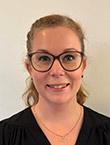
About Emy Hurtig
Emy is a registered occupational therapist with a Master’s degree in Occupational Therapy. She works clinically as a vision rehabilitation specialist at Region Skåne’s Deafblind Service and also contributes her expertise in vision rehabilitation to the National Knowledge Centre for Deafblindness (Nkcdb), which, on behalf of the Swedish National Board of Health and Welfare, works to develop and disseminate knowledge to professionals in the field of deafblindness.
Emy has a central research interest in orientation and mobility for people with deafblindness. Her research questions are grounded in several years of clinical experience and in encounters with people with combined vision and hearing loss/deafblindness. The ability to orient and move independently is a prerequisite for active participation in everyday activities and for being able to independently choose and participate in different contexts.
People with deafblindness need to be able to orient and move independently in order to participate in the contexts and activities they choose. At the same time, there is a lack of evidence-based methods for how professionals can provide orientation and mobility training for people with deafblindness.
In her Master’s thesis, interviews with professionals who had provided orientation and mobility training to people with deafblindness showed that the national standard for orientation and mobility for people with visual impairment or blindness can also be used for people with deafblindness. The findings also indicated that many components need to be adapted to the individual’s circumstances and needs.
As part of a development project within Region Skåne, a guide has been developed to support the adaptation of the orientation and mobility standard for people with deafblindness.
In her doctoral research, Emy investigates the usability of the guide from the perspectives of both professionals and people with deafblindness. The research also aims to contribute new knowledge about rehabilitation interventions in orientation and mobility for people with deafblindness in a Swedish context.
The overall hope is that the doctoral research will contribute to people with deafblindness having opportunities to develop their orientation and mobility skills, and that training will be provided with high quality and in an equitable manner, regardless of who delivers the intervention.