

"A Handle on Everyday Life" - Time Management, Self-Efficacy, and Mental Health Among Young People
About this project
Project information
Many young people who do not meet the eligibility requirements for upper secondary education face challenges that may affect their opportunities for further education, employment, and participation in society. An important factor for success in both studies and everyday life is the ability to plan, organize, and manage time effectively. At the same time, approximately 130,000 young people in Sweden are living in social and educational exclusion, many of whom have left compulsory school without passing grades.
This project aims to strengthen young people's self-efficacy and mental health and prevent social exclusion by developing and evaluating support for planning and time management. The target group consists of young people aged 16-20 enrolled in the Introduction Programme (IM) in upper secondary school.
The project builds on Let’s Get Organized (LGO), a ten-week group intervention that has demonstrated positive effects for adults with cognitive difficulties. Since the intervention in its current form is not adapted for adolescents, the project will develop a youth-oriented version, Let’s Get Organized-Youth (LGO-Youth), in close collaboration with the target group.
Project Aim
The overall aim is to promote long-term independence among young people who lack upper secondary school eligibility by:
- mapping the relationships between time management, stress, and self-efficacy;
- developing an adolescent-adapted version of LGO in collaboration with young people themselves;
- implementing and evaluating the intervention in a school setting.
The project consists of three sub-studies:
1. Mapping Time management and stress
A study of time processing ability, time management, stress, and self-efficacy among students enrolled in the IM in upper secondary school.
2. Co-creation and Development of LGO-Youth
Adaptation of the LGO group intervention through a co-creation process in which students from the Introduction Programme actively participate in the development. The adaptation is based on their experiences, needs, and everyday contexts.
3. Evaluation of the Intervention
The effects of LGO-Youth will be examined in a randomized controlled trial, focusing on participation, self-efficacy, perceived stress, and abilities related to planning and time management.
Expected Outcomes
The project will generate new knowledge about the support that young people experiencing educational and social exclusion need in order to develop effective strategies for planning and time management. The study will also provide insights into the intervention’s impact on academic outcomes, self-efficacy, participation, and mental health as well as the associations between time management and stress in youth.
An important outcome of the project will be an evidence-based intervention package that can be used within the IM and upper secondary schools to support young people's learning, well-being, and opportunities for independent living.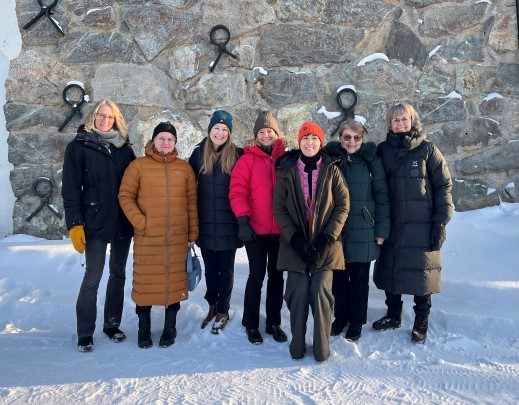
The researchgroup in januari 2026, from left: Johanna Åkerlund, Sara Wallin Ahlström, Camilla Udo, Kajsa Lidström-Holmqvist, Nina Klang, Gunnel Janeslätt och Marie Holmefur. Maria Wingren is missing in this picture.